
Dormition

The Dormition of the Holy Theotokos
Saturday 29th August 2026 A.D.
Good Shepherd Chapel, Abbotsford
As evening settled over Abbotsford, the bells called the faithful once again to prayer. Inside the chapel, the gentle sound of the organ welcomed those arriving and drew us away from the noise of the world into the quiet beauty of this most tender feast — the Dormition of the Holy Theotokos. Tonight we gathered to remember the falling asleep of Mary, the Mother of God. It is a feast touched by sorrow, but never overcome by it; a commemoration of death illuminated by the promise of life.

From the opening hymns and prayers, the liturgy invited us to contemplate the woman whose quiet “yes” changed the course of human history. Mary received Christ within her womb, carried Him into the world, stood beside Him throughout His earthly life, remained at the foot of the Cross, and rejoiced with the Church in His glorious Resurrection. Now, at the end of her earthly life, the Church gathers around her.

Metropolitan Raffaele explained that, according to Holy Tradition, as the time of her Dormition approached, the Apostles were miraculously gathered from throughout the world to be at her side. Those whom Christ had sent out to the nations returned once more to the Mother who had shared in the earliest life of the Church. Her departure was not one of fear, but of peace.

The word 'dormition' means falling asleep, expressing beautifully the Christian understanding of death. For those who live in Christ, the grave does not have the final word. Death becomes a passage — a sleep from which we await awakening in the Resurrection. The Metroploitan turned our attention toward this great hope. The same Mary who carried Christ in her arms is now carried by Him into eternal life. In icons of the feast, the Theotokos lies peacefully surrounded by the Apostles, while behind her stands the risen Christ, holding her soul in His arms like a small child. It is a beautiful reversal: the Mother who once carried the Child is now carried by her Son.

Next, Father Matthew brought Father Mark up to the Altar and announced that the Synod had assigned Vicar General Father Mark the decree of See of Regional Victoria. Father Mark began his confession of faith in front of the bishops.

Next, the clergy began the litany of saints, calling all the angels and saints to pray for the new candidate for the episcopacy.

Then, Father Mark was consecrated a bishop.

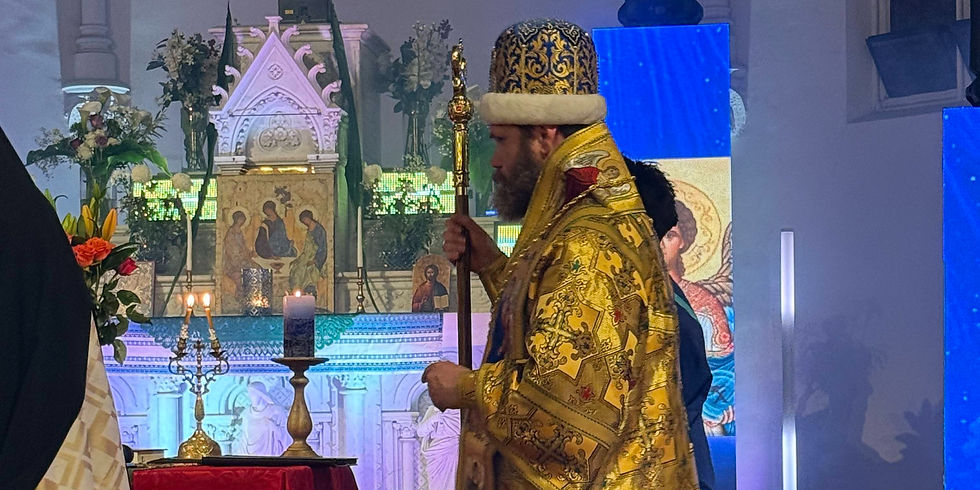
Next, he was vested in the attire reserved for bishops - the Saccos, Omophorion, crown, and staff.

Once the consecration was complete, the gospel was brought among the people. Reader Patrick read from one of Paul's letters to the Philipians. It spoke of humility over pride, putting the needs of others ahead of our own, and living in obedience and love.

The gospel was brought among the people and Father Matthew read from St Luke's gospel. It spoke of the time Jesus visited Martha and Mary. Martha is upset that Mary has chosen to sit by Jesus, rather than help prepare the food serving. Jesus tells her that Mary has chosen the 'better part' and this will not be taken from her.

In his homily, Metropolitan Raffaele reflected on the Dormition as a feast of hope, fulfilment, and reunion rather than an ending. He began with the Annunciation, explaining that the world needed faith, hope, love, and change, and that these entered the world through Mary’s willingness to say yes to God. Through her, Christ took on our humanity, and from the Cross He entrusted His Mother to St John, who cared for her during the later years of her life.

He then drew a powerful connection between the womb and the tomb. Mary offered Christ a womb through which He entered the world, while Joseph of Arimathea offered Him a tomb. Through the Resurrection, however, the tomb itself became like a womb, bringing forth new life and salvation. When the Archangel Gabriel announced that Mary’s earthly life was nearing its end, she did not respond with fear, but with joy at the thought of being reunited with her Son and being made complete in God.

According to Holy Tradition, the Apostles gathered around Mary at her Dormition, although St Thomas arrived three days later. When the tomb was opened for him, her body was no longer there; only a sweet fragrance and neatly folded burial cloths remained. Metropolitan Raffaele compared these cloths with those found after Christ’s Resurrection, explaining that a folded cloth could signify that the master would return. Mary’s empty tomb therefore became a sign that death had not defeated her, but that she had been received into eternal life by the Son whom she had faithfully carried into the world.

The Dormition reminds us that our own lives are also journeys toward completeness in God. Like Mary, we are called to trust, to remain faithful, and to say yes to God even when the path ahead is uncertain. Her falling asleep teaches us that death is not the final word for those who live in Christ. Instead, it is a passage into the fullness of life promised in the Resurrection. Through the prayers of the Holy Theotokos, may we learn to live with the same faith, hope, and love that marked her life, trusting that Christ will one day gather us also into His eternal presence.

Then, as the liturgy continued, the gifts of bread and wine were brought solemnly to the altar and the faith of the Church was proclaimed together in the Creed. The Sanctus united our voices with the worship of heaven before the gifts were blessed and transfigured through prayer. It was especially fitting on this feast that we then turned toward the Theotokos, honouring the one who gave herself completely to God. Her life was never about drawing attention toward herself; rather, everything in her life pointed toward her Son.

Together we prayed the Our Father, before the Agnus Dei accompanied the preparation of Holy Communion. The clergy received first, followed by the faithful, approaching the chalice to receive the same Christ whom Mary once carried within her.

The liturgy then moved toward thanksgiving, our prayers filled not simply with remembrance, but with hope. The Dormition teaches us something profound about both life and death. Mary's holiness was not found in worldly power or greatness. It was found in faithfulness — in listening, trusting, serving, enduring, and continually saying yes to God. Her life reminds us that holiness is often quiet. It can be found in caring for another person, in remaining faithful through difficulty, in offering forgiveness, in prayer when nobody else is watching, and in allowing God to work through the ordinary circumstances of our lives. And her Dormition reminds us that our earthly journey has a destination.

We mourn those whom we love when they leave us, just as the Apostles mourned the departure of the Theotokos. Yet Christian grief is always accompanied by hope. Christ has entered death Himself and shattered its power. The tomb is no longer simply an ending; through Him, it has become the doorway to Resurrection. As the final hymns were sung and the evening drew to its close, we left carrying with us the gentle message of this beautiful feast: Do not be afraid. Remain faithful. Trust in Christ.

Through the prayers of His Most Holy Mother, may He guide us through the joys and struggles of this life, and finally gather us together into the life that has no end. Metropolitan Raffaele closed the evening by thanking everyone: his clergy, the servers, and those who had contributed to the evening. He congratulated our newly appointed Bishop Mark and invited us to celebrate with a spectacular light show and feast afterwards.


Comments