
Conception of St John the Baptist

Saturday 3rd October 2026
Good Shepherd Chapel, Abbotsford
The evening was peaceful and expectant as the people arrived for tonight's liturgy, commemorating the conception of St John the Baptist. Metropolitan Raffaele welcomed the congregation, chatting warmly with each group as they arrived. He then disappeared for a moment and the bells rang out across Abbotsford, welcoming the faithful once again to Good Shepherd Chapel. The Metropolitan returned, welcomed those still arriving before taking his place at the organ, filling the chapel with gentle music as everyone settled.
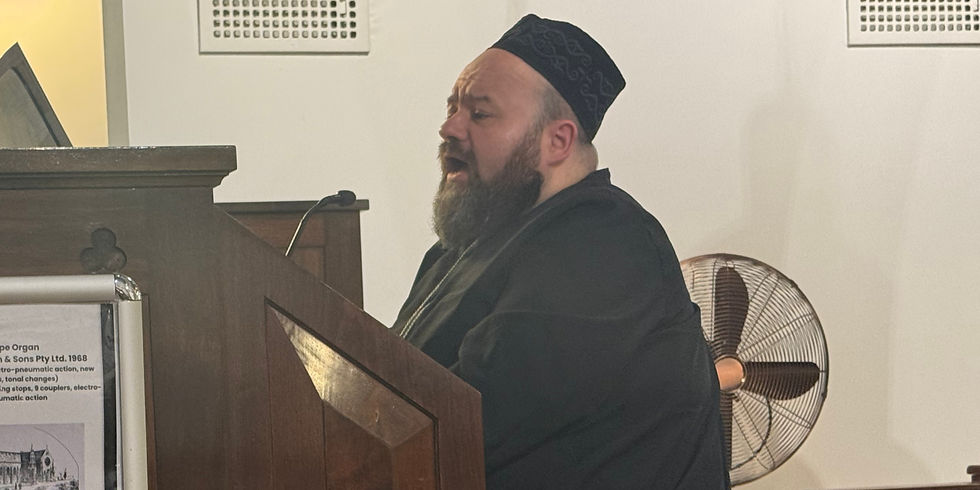
Inside, the church was simply dressed for the evening, with red and white accompanied by small touches of green, gold and blue. There were no elaborate lights or decorations tonight; instead, the familiar chapel provided a peaceful setting in which the community could gather together in prayer. There was, however, something particularly special about this liturgy. Father Bishop Mark, vested in gold, prepared at the prothesis with Father Matthew for the first liturgy he would lead as a bishop.

The clergy entered as Metropolitan Raffaele sang and played The Lord Is My Shepherd, and the liturgy began with the Common Prayer, followed by the Kyrie. Next, the Gloria was sung, rendering true worship to God and rightfully glorifying his presence in the world.

Reader Patrick then proclaimed the Epistle from St Paul’s Letter to the Galatians, which contrasted the present Jerusalem with the Jerusalem above, and reflected on those born according to the flesh and those born according to the promise of God. The reading also proclaimed, “Rejoice, O barren woman,” as St Paul drew upon the story of Sarah and Hagar.

The Gospel was brought amongst the people and Father Matthew read from, Father Bishop Mark presented his first homily after his Consecration.
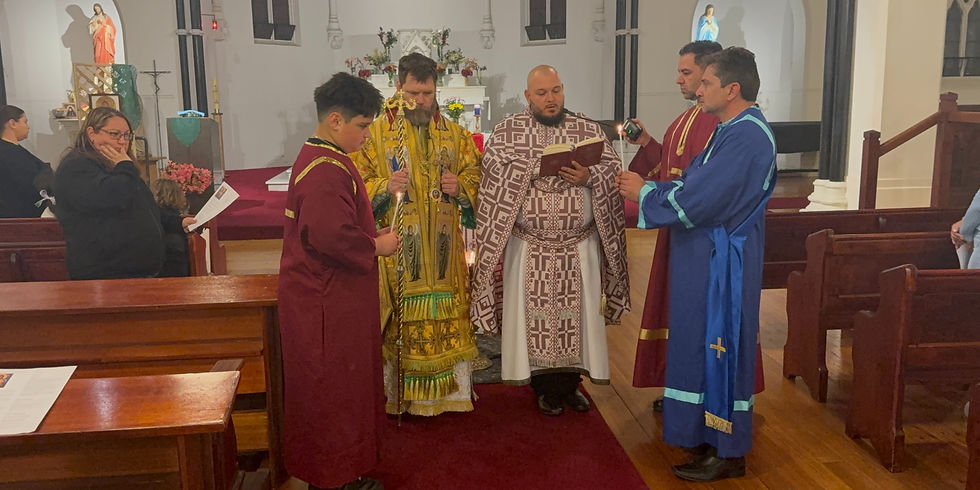
Father Bishop Mark began by reflecting on St John the Baptist, who came to announce Christ — the One who would give His life so that we might have life. At the time, many people longed for a powerful earthly ruler who would restore their nation, but Christ came in a very different way. He came not to be served, but to serve, ultimately offering Himself upon the Cross so that our fallen human nature might be raised with Him.

He reminded us that God knows our weaknesses and understands that we will not always make the right choices. Like the father in the parable of the Prodigal Son, God is not waiting to punish us for every failure, but rejoices when we return to Him with humility and repentance. For this reason, Father Bishop Mark encouraged us never to despair. Even in times of spiritual dryness or difficulty, we should turn ourselves back towards Christ and trust that He will gently guide us where we need to be.

He then reflected on his episcopal motto, “Rejoice in the Lord always,” reminding us that Christians are called to be people of joy. We bring others towards Christ not by judging them, but by allowing His love to be seen through us — perhaps through something as simple as a smile, helping a neighbour, or noticing someone who is struggling. Through the Holy Mysteries, especially the Eucharist, we are strengthened to continue this work and to become the hands and feet of Christ in the world. He concluded by encouraging everyone to pray and ask God to show them the small ways in which they can help others experience His goodness and love.

The liturgy continued with the Kyrie, before the gifts were solemnly brought forward.

Metropolitan Raffaele joined Father Bishop Mark and Father Matthew at the altar as the prayers continued. Peace was offered, and prayers were raised for the faithful departed before together we proclaimed the Creed.

The Sanctus was sung as the gifts were prepared upon the altar. Then, at the Epiclesis, the Church called upon the Holy Spirit, asking that the gifts be transformed and sanctified. Bread and wine, offered from the gifts of creation, became the sacred mystery of Christ’s presence.
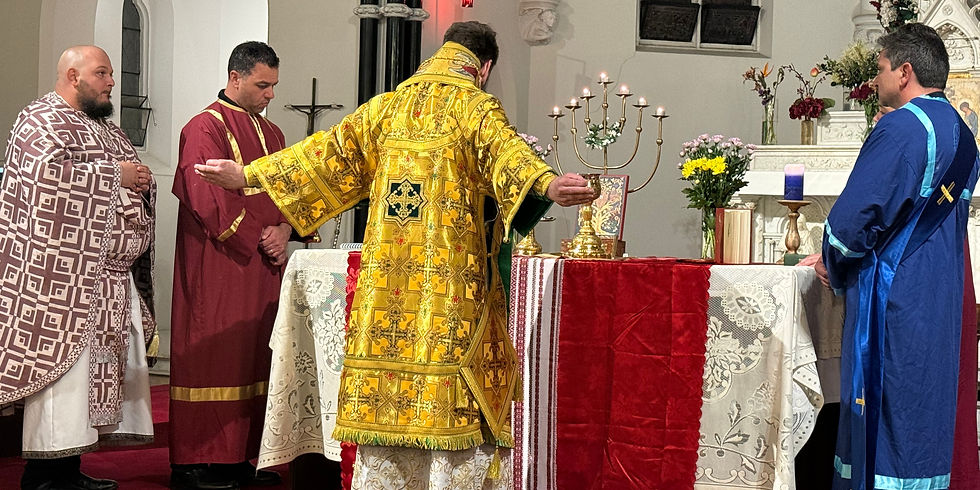
Our prayers then turned towards the Theotokos, remembered as the 'New Eve', whose obedience opened the way for Christ, the 'New Adam', to restore what had been lost in the Garden of Eden. Together we prayed the Hail Mary, before Metropolitan Raffaele led the hymn to the Theotokos from the organ.

Then, led by Father Bishop Mark, the congregation prayed the Our Father together. Next, an old tradition returned and the clergy sang the prayer in beautiful harmonies!

Father Matthew washed Father Bishop Mark’s hands as the Holy Mysteries were prepared for Communion, and the Agnus Dei was sung. The clergy then received Holy Communion.

As communion was prepared for the congregation, Metropolitan Raffaele reflected on St John the Baptist as the one who came before Christ to bear witness to the Light and prepare the way of the Lord. He explained that, in the Byzantine tradition, the Gospel is accompanied by light because St John himself came as a witness to Christ, preparing not only the living but also those who had gone before. Through Christ, God came among us to break the power of the ancient rebellion, restore what had been lost, and renew us through Baptism in the image of His Son.

He described St John as the last of the Old Testament prophets and one of the first witnesses of the New Testament, fulfilling the words of Isaiah: “Prepare the way of the Lord.” John’s task was to awaken hearts and prepare God’s people for the coming of the Redeemer. Metropolitan Raffaele connected this with the image of Christ as the Good Shepherd, explaining the distinction between the sheep and the goats. The sheep remain close to the shepherd and depend upon him, while the goats wander and follow their own direction.

He encouraged us therefore to remain as sheep of Christ’s flock, listening to the Word of God, keeping it in our hearts, and resisting the distractions of the world which can draw us away from the voice of the Shepherd. St John the Baptist reminds us to remain faithful to our Baptism and to continually hunger for Christ, who gives Himself to us in the Holy Eucharist. As the Psalm says, “Taste and see that the Lord is good,” and, “As the deer longs for running streams, so my soul thirsts for you, my God.”

The faithful then came forward to receive Holy Communion.
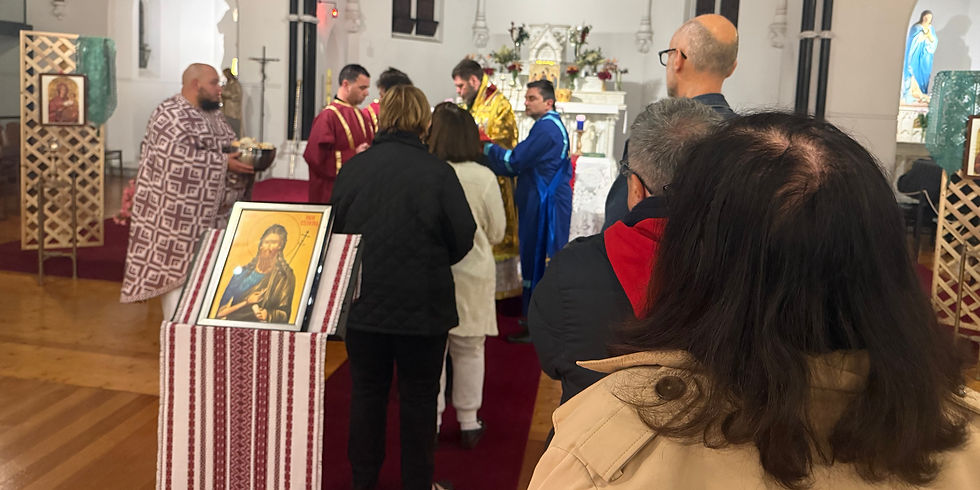
As the sacred vessels were purified and returned to the prothesis, Metropolitan Raffaele returned to the organ, filling the chapel once more with music while the congregation remained in prayer. The Thanksgiving Hymn was sung and the clergy returned to the main altar.

At the conclusion of the liturgy, the faithful were invited to venerate the relics of St John the Baptist — the great Forerunner who devoted his life to preparing the way for Christ. St John’s whole life was one of repentance, preparation, and witness. He called the people to turn again toward God and prepared the way for the coming of Christ. His example reminds us that the Christian life is one of continual conversion — allowing the grace of God to transform us, cleansing what has become disordered within us, and drawing us ever more deeply into communion with Him. Through prayer, repentance, the Holy Mysteries, and the life of the Church, we too are called to grow in holiness and become more fully what God created us to be.

St John sought no glory for himself; everything he did pointed beyond himself towards Christ. His life challenges us to do the same: to make room for God, to allow ourselves continually to be changed by Him, and through our own lives to help others encounter Christ.

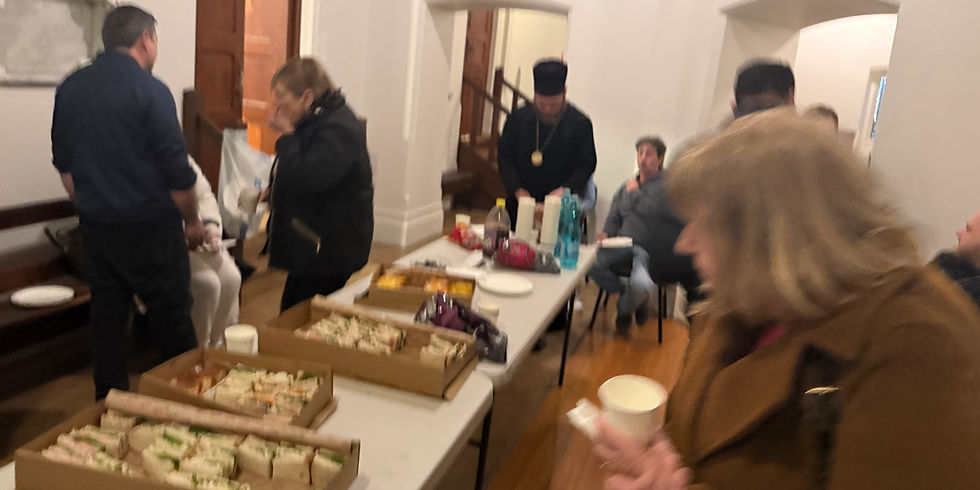
With the liturgy concluded, everyone gathered together for agape, sharing conversation, fellowship, and, as always, something good to eat.


Comments