Pentecost
- Admin

- Jun 1
- 5 min read
Saturday 30th May 2026 - 7pm
Good Shepherd Chapel, Abbotsford
The chapel was adroned in green, the colour of life, renewal, and the Holy Spirit. As the bells rang out across Abbotsford, the soothing sound of the organ welcomed the faithful into the church. The atmosphere was peaceful and expectant, as we gathered to celebrate the great feast of Pentecost, the day on which the Holy Spirit descended upon the Church.

The liturgy began with the Entrance Hymn, after which Metropolitan Raffaele reflected upon the mystery of the Burning Bush. Just as the bush burned yet was not consumed, so too the fire of God descended upon the Apostles without destroying them. He spoke of the one hundred and twenty Apostles and disciples gathered in prayer when the Holy Spirit came upon them as tongues of fire, sealing and sanctifying the newborn Church. It is the same divine fire, he reminded us, that continues to guide us into truth today.

The Kyrie was sung as the Metropolitan incensed the altar as the prayers of the Church rose heavenward. Then, Father Mark proclaimed the reading from the Acts of the Apostles, recounting the first Pentecost, when the disciples spoke in many languages and people from every nation heard the Gospel in their own tongue. The miracle was not merely one of speech, but of understanding—a sign that the Holy Spirit gathers all peoples into the one Body of Christ.

The Gospel was brought among the people, and Metropolitan Raffaele read from St John. We heard Christ's invitation: “If anyone thirsts, let him come to me and drink.” The Gospel also recounted the woman caught in adultery, whom Christ rescued from condemnation, declaring that only one without sin may cast the first stone. Finally, we heard His proclamation: “I am the Light of the World.”

In his homily, Metropolitan Raffaele reflected on the mercy of Christ. The woman brought before Him had become a scapegoat for the sins and agendas of others. While her accusers sought judgment, Christ offered something greater—truth, mercy, and the possibility of a new beginning.
The Metropolitan then pondered the question that has intrigued Christians for centuries: What was Jesus writing in the dust? Perhaps, he suggested, Christ was writing the names and hidden sins of those gathered around Him. One by one they dropped their stones and departed, for no secret remains hidden before God.

Rather than condemnation, Christ offered the woman hope. “Go in peace.” The same invitation is extended to us.

Metropolitan Raffaele then explained that Pentecost comes fifty days after Pascha, during the season of harvest. Christ declares Himself to be the Living Water, inviting all who thirst to come and drink. Through baptism we are born of water and fire, receiving the grace of the Holy Spirit.
The Metropolitan reminded us that grace is freely given, yet we are called to cooperate with it. God meets us halfway. Our struggles, relationships, worries, and responsibilities can leave us spiritually unbalanced, but divine grace often comes most clearly in silence.

Many people fear silence because it forces us to confront difficult questions: Where am I going? What am I becoming? Yet it is often in that stillness that God speaks.

He spoke of the saints, noting that many were misunderstood, criticised, or rejected by those around them. Yet God sustained them with grace. Through serving others, healing begins within us as well. The saints were sent into the world to shake things up—not through power or status, but through holiness. Often they concealed their sanctity beneath ordinary lives, while God quietly invested them with extraordinary grace.

Metropolitan Raffaele then turned to the question of relics. Why, he asked, do Christians venerate bones and holy objects? He recalled the story of Elisha, whose bones restored life to a dead soldier when they were touched. He spoke also of St Paul, whose garments carried such grace that people were healed by touching them. These relics are not magical objects; rather, they have been touched and transformed by the presence of the Holy Spirit. Through them we encounter God's power, love, and grace.

Pentecost renews that same Spirit within the Church. We are the people of God, called to carry His presence into the world.

Prayers were then offered for the departed before the liturgy continued. The gifts were brought forward in the offertory procession, the Creed was proclaimed, and the Sanctus was sung. The gifts were blessed and prepared for the sacred mysteries.
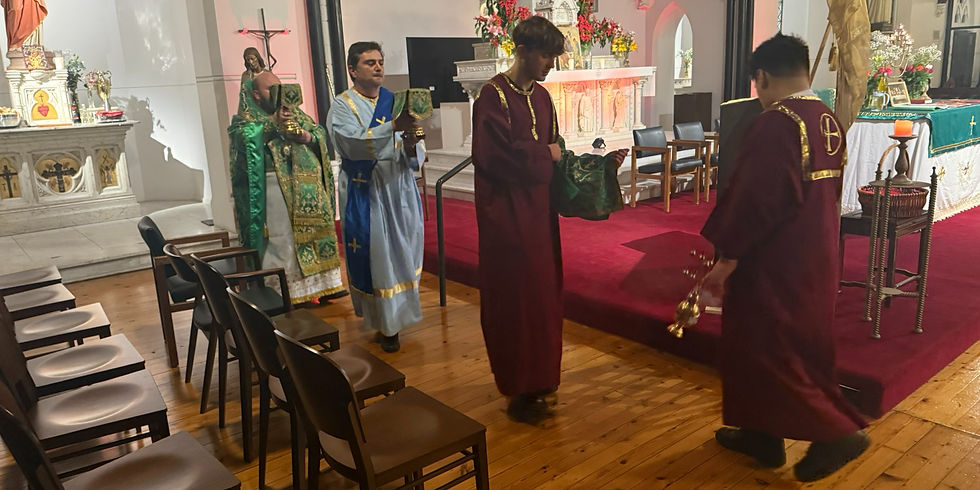
Metropolitan Raffaele briefly reflected on the upcoming Monday of the Holy Spirit, reminding us that in prayer we ask rather than demand, trusting in the goodness of God. The gifts were then transfigured through prayer.

We honoured the Theotokos, and together prayed the Our Father. The Agnus Dei was sung as Holy Communion was prepared.

The clergy received Holy Communion while Father Mark played a contemplative piece on the organ. During this time Metropolitan Raffaele offered gentle reflections on God's provision, drawing images from feeding birds, the pelican as a symbol of Christ's sacrifice, and the humble prosphora bread offered by the faithful.

The congregation then came forward to receive Communion.

As the sacred vessels were purified, Father Mark again filled the church with beautiful organ music—joyful yet reflective, carrying the peace of the feast. A Thanksgiving Hymn followed.

One of the most distinctive moments of Pentecost came with the Kneeling Prayers. The congregation knelt as Metropolitan Raffaele and Father Mark offered prayers invoking the Holy Spirit and seeking God's mercy upon the world.

The prayers then turned to the blessing of holy oil. Metropolitan Raffaele recounted the story of Saint Helena and the discovery of the Holy Cross beneath a basil plant, reminding us of the connection between faith, healing, and the grace of God.

He shared the story of a Greek woman whose son had been paralysed after a terrible accident. Desperate for help, she sought a fragment of the True Cross. A dishonest bishop, unwilling to help sincerely, presented her with an ordinary splinter of wood. Yet the woman received it with unwavering faith. For three months, holy oil flowed from the splinter, and her son was eventually healed. When the bishop confessed his deception, it became clear that the miracle had not come through the object itself, but through the woman's faith and God's mercy.

"Do you have faith?" Metropolitan Raffaele asked. Then he reminded us that "Fear is often the absence of faith."

The blessed oil was then distributed to the faithful. The altar servers carefully filled small vessels, and each person received some of the newly blessed oil to take home.

The evening concluded with agape, as the community gathered once more in fellowship, carrying with them the blessings of Pentecost and the renewing grace of the Holy Spirit.


Comments